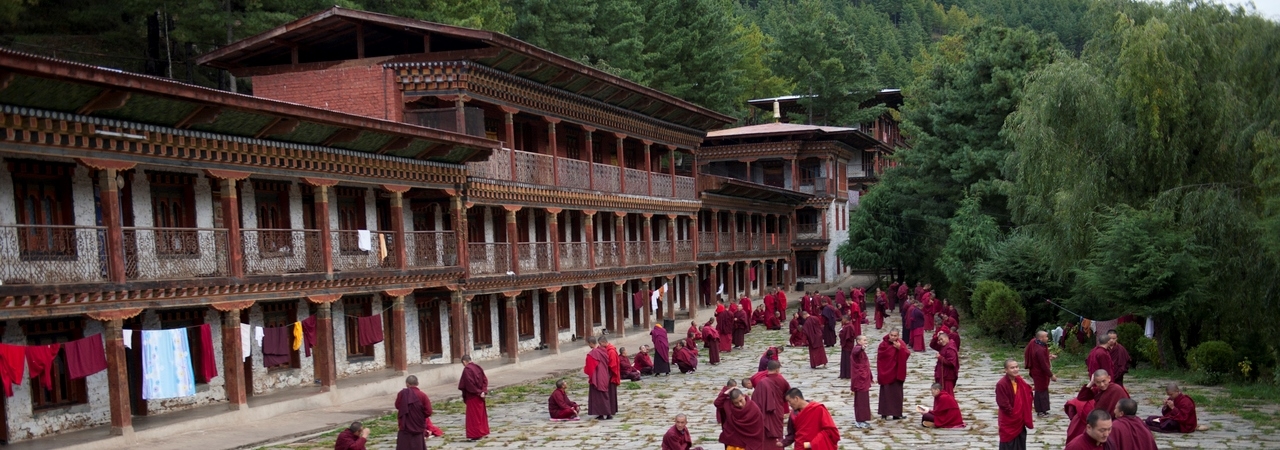
Nestled in the folds of the Eastern Himalayas, remaining in self-imposed isolation for centuries, Bhutan opened up to the world in a glacial pace. The population lived in close harmony with nature, evolving a unique identity, derived largely from a rich religious and cultural heritage. This country of 700,000 people, roughly the size of Switzerland, is the world’s only Mahayana Buddhist country. The Buddhist respect for all sentient beings helped Bhutan protect its pristine ecology and wildlife.
This self-sufficient population was never colonized and had limited contact to the outside world. Buddhism was established in the 8th century by the Indian saint Padmasambhava, popularly known in the Tantric tradition as Guru Rinpoche. Perhaps the most dynamic era in Bhutanese history came in the 17th century with the arrival, in 1616, of Zhabdrung Ngawang Namgyal, the great leader of the Drukpa school of Mahayana Buddhism. He unified the country and established the foundations for national governance and the Bhutanese identity.
In 1907, a historic Assembly of the clergy, the official administration, and the people unanimously elected Gongsar Ugyen Wangchuck as the first hereditary King of Bhutan thus beginning the glorious era of the Wangchuck dynasty. In 2006, the fourth king of Bhutan, Jigme Singye Wangchuck announced that he would abdicate in favor of a constitutional monarchy with a parliamentary democracy. In 2008, the year that marked 100 years of the monarchy saw two important events; the first democratic elections and the coronation of the fifth king, Jigme Khesar Namgyel Wangchuck.
Minimum 2 persons travelling together
|
Departure Dates
| Hotel | Solo Traveller (Single Room) | (Minimun 2 Pax) Per Adult H/Twin | (Minimun 3-4 Pax) Per Adult H/Twin |
|---|---|---|---|---|
|
04,06Feb |
Four Star Hotels |
33,880 | 25,180 | 24,480 |
| Five Star Hotels |
59,980 | 35,780 | 35,280 |
Five Star Hotels: Thimphu: Le Meridien , Gantey: Taj, Punhaka: Dhensa , Paro: Dawa at Hilltop by Heetan
Four Star Hotels: Thimphu: Tashi Yidwong Grand Hotel or Hotel Ariya , Gantey: Gangtey Tent or Pinewood Resort, Punakha: Lobesa Boutique Hotel or Zhingkham Resort , Paro: Kaachi Grand or Tashi Namgay Resort
| Day 01 | HK/Paro B3 789 05:20-08:20 |
|---|---|
|
Guests will fly to Paro, one of the most spectacular flights in the entire Himalayas. Upon arrive in Paro by plane, then proceed to Thimphu (55 km, approx. 1.5 hours drive) Bhutan's first gift to you is the cool, fresh mountain air as you disembark. After completing immigration and baggage claim, our staff will greet you and you will be driven to Thimphu, the capital of Bhutan, stopping en route at Chuzom, the confluence of the Thimphu and Paro rivers. Three different styles of stupas—Tibetan, Nepalese, and Bhutanese—adorn this confluence. Shortly before reaching Chuzom, you will see Tschogang Lhakhang, "Horse Temple," on your left. This is a private temple built in the 15th century as a result of a visit by Balaha, a manifestation of the compassionate Buddha Chenrezig. Upon arrival in Thimphu, check into your hotel. Thimphu, the capital of Bhutan and its governmental, religious, and commercial center, is a unique city that remarkably blends modern development with ancient traditions. With a population of approximately 90,000, Thimphu may still be the only capital city in the world without traffic lights. The King's Memorial Stupa: People continuously circumambulate the stupa, whispering mantras and turning prayer wheels. This landmark was built at the behest of His Majesty Jigme Dorji Wangchuck, the third King of Bhutan ("Father of Modern Bhutan"), who wished to create a monument symbolizing world peace and prosperity. Completed in 1974 after his untimely death, the stupa serves both as a memorial to the late King and a monument to peace. In the evening, stroll along Thimphu's main street and market district. Visit the local handicraft market to admire a prime example of Bhutan's exquisite traditional art. Here you can purchase handwoven textiles, thangkas, masks, pottery, stone and wood carvings, jewelry, and interesting items made from local materials.
|
|
| Day 02 | Thimphu - Gantey(around 5 hours drive) |
|
After breakfast, drive via Dochula Pass to Gantey. All mountain passes in Bhutan feature large Bhutanese-style stupas and prayer flags. On clear days, Dochula Pass offers magnificent panoramic views of the towering peaks of the Eastern Himalayas. En route, you will pass Wangdue Phodrang. You may visit the local market and explore this newly developed town. Wangdue Phodrang is famous for bamboo crafts, slate and stone carvings. The Gantey Valley ranks among Bhutan’s most scenic attractions. In the afternoon, take a leisurely walk around Gantey Village. Visit Gantey Goemba, the only Nyingma monastery in the area, and stop by Khewang Lhakhang. You can also visit the Black-necked Crane Information Centre. It has an observation room equipped with high-powered telescopes and long-range viewing gear for visitors to spot black-necked cranes. There is also an exhibition area introducing the natural and cultural history of the region in detail. |
|
| Day 03 | Gantey - Punakha |
|
After hotel breakfast, drive to Punakha to visit Punakha Dzong, widely regarded as Bhutan’s most beautiful dzong. This magnificent fortress sits at the confluence of two rivers. It served as Bhutan’s capital before 1955 and remains the winter residence of the Bhutanese monastic body to this day. In the afternoon, visit Chimi Lhakhang, the renowned Fertility Temple. Drive for approximately 15 minutes, then hike through rice paddies and villages (around 1.5 hours round‑trip). Also known as the “Fertility Temple”, Chimi Lhakhang is famed for the legend that childless couples who pray here may be blessed with childrenchimilhakh.... Walk across rice fields to Phana Village, whose name means “farmland”. Stroll around the villages surrounding the temple to experience authentic local Bhutanese culture and daily life. In the evening, wander leisurely through Punakha village along the riverside. |
|
| Day 04 | Punakha - Paro(120 KM / around 4.5 hours car ride) |
|
After breakfast, drive back to Paro. En route, visit Simtokha Dzong, Bhutan’s oldest dzong fortress built in 1627, which now serves as a Buddhist institute. Upon arrival in Paro, check in to your hotel. After lunch, visit Ta Dzong. Originally a watchtower, it is now the National Museum. The museum houses an extensive collection of ancient thangkas, textiles, arms and armour, daily artefacts, together with a wide range of natural and historical exhibits. It is the ideal place to discover Bhutanese culture. Continue downhill on the walking trail to visit Rinpung Dzong (Paro Dzong), known as the “Fortress of the Heap of Jewels”, boasting a long and splendid history. The wooden corridors in the inner courtyard are decorated with exquisite murals depicting Buddhist stories: the Four Friends, the Longevity Sage, the Wheel of Life, scenes from the life of Milarepa, Mount Meru and other cosmic mandalas. |
|
| Day 05 |
Paro |
|
After breakfast, embark on today’s hiking trip to Tiger’s Nest, one of the world’s most iconic monasteries. Perched majestically on a 900-metre cliff, it is known as Tiger’s Nest as legend says Guru Padmasambhava arrived here on the back of a tiger to meditate. Every Bhutanese makes at least one pilgrimage here in their lifetime. A major fire on 19 April 1998 severely damaged the main structure, yet this Bhutanese treasure has been restored to its former glory. In the late afternoon, visit Kyichu Lhakhang, built in the 7th century. It is one of the 108 monasteries constructed by King Songtsen Gampo across the Himalayas, marking the official arrival of Buddhism in Bhutan. |
|
| Day 06 | Paro-HK B3 788 16:00-23:50 |
|
After breakfast at the hotel, we will drive to the airport for your flight back to HK. Our guide will assist you with departure procedures and then say goodbye. |
|
| Package price includes |
|---|
|
| Package price not includes |
|---|
|
| Notes |
|---|
|
| Special & Highlight |
|---|
|
| Hotel Surcharge (per room per night) |
|---|
|
Hotel upgrade:
Please contact us for surcharge on hotel upgrade |
UD: BW/06MAR26
UD: BW/06MAR26
Back to Top